“Art must be an integral part of the struggle. It can’t simply mirror what’s taking place. . . It must ally itself with the forces of liberation.” Charles White 
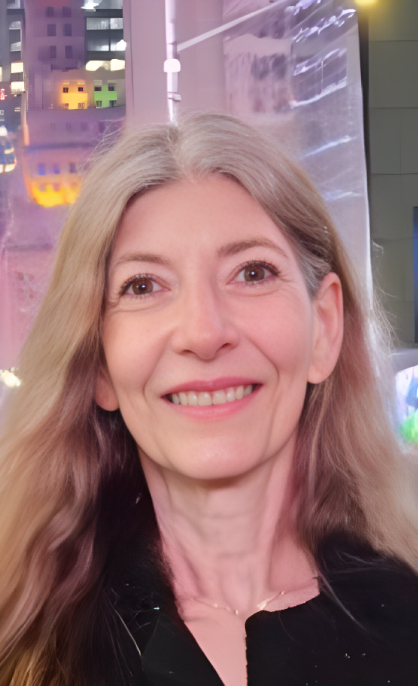
Amy Spitzer has worked as an artist for almost 50 years. As a child, she loved to draw and paint and began her journey as an adult artist after participating in a foreign studies program at Waseda University in Tokyo and living with a Japanese family.
The arts, which pervade Japanese culture and activities of daily living, reawakened Spitzer’s own need to express herself as a painter.
Several years later, after completing painting and drawing classes at Wellesley College, Amy became a private student of acclaimed painter Richard Yarde, and then returning to Chicago in 1978, she briefly studied painting and color at the School of the Art Institute of Chicago.
Since then Spitzer has continued to teach herself a painting method used by master painters from the Renaissance to the 19th century and adapted it for contemporary materials and expression.
Over the years, she has been in conversation with other contemporary artists and has exhibited in various national and local shows juried by notable artists, critics, and curators. Beyond the contemporary art scene, she has leveraged her work experiences in social networking and online marketing to gain an even wider audience for her work as an artist and as a teacher. Through her love of art, people, and conversation she aims to connect with a broad public interested in contemporary, modern, and historically significant works.


I continuously strive to abandon internal controls that do not serve me in life or as a practicing artist. I struggle with everyday life experiences and work to freely express those challenges in my painting. These efforts and my appreciation of blessings shape my vision.
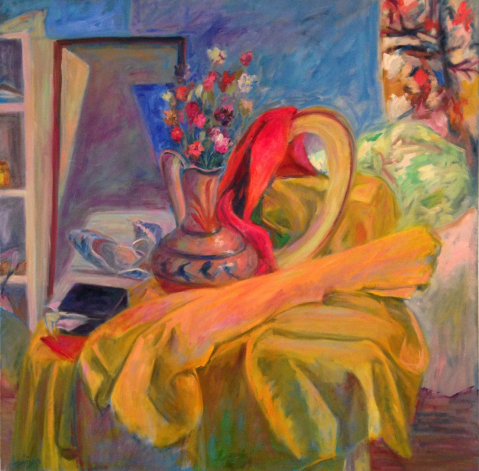
From the start, I have represented my inner world as a three-dimensional realm—sometimes an interior with a window view or a mirror reflecting
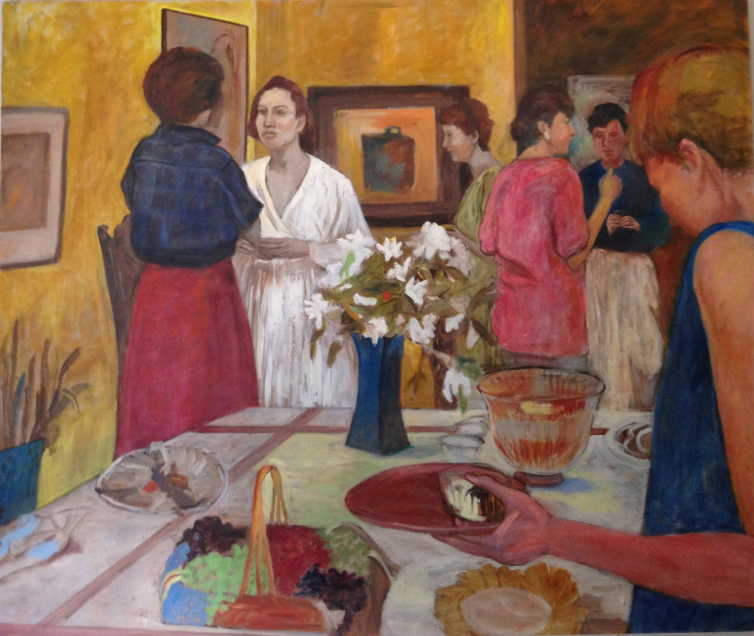
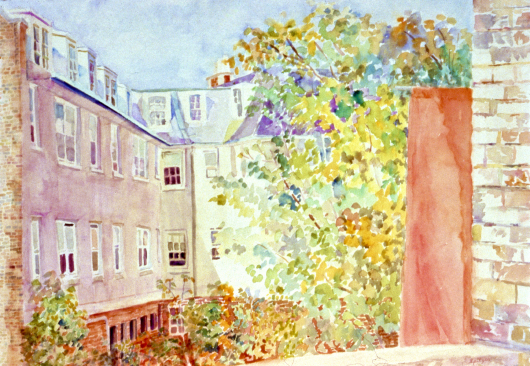
an imaginary place or sometimes just a landscape or people gathering or a person, a portrait. However, the painting is a unified, impenetrable
surface of flat shapes (a puzzle) and I want viewers to see/understand this dimension as well. A painting is a paradox as is life.
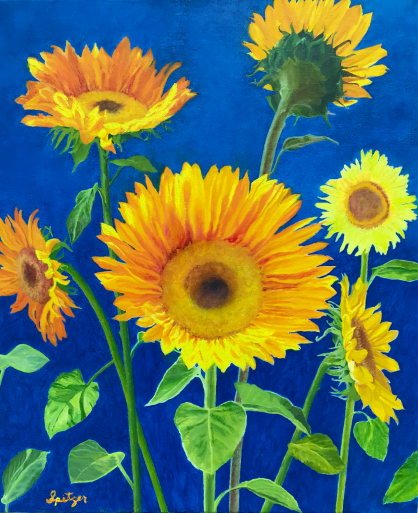
I manipulate what seem to be opposing dimensions and ideas to create work that has dynamic unity. Two sunflower stems that overlap
change to an X-shape, a table reflected in a mirror transforms into a table that is running into the mirror and the frame of the mirror
becomes a simple, rectangular contour. Often, the viewer doesn’t see these individual manipulations, but if I’m successful
they stimulate a more sustained and imaginative reflection and a feeling that they are looking at something of life,
something that changes from one thing to another and then another.