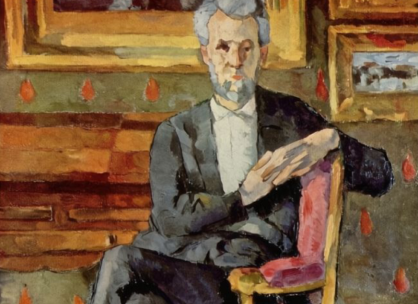
Victor Chocquet was one of a small group of early supporters of the Impressionists before the group had received recognition for their work. Although he only had a moderate income, he was a passionate collector of paintings, drawings, and other assorted possessionsof value. He was sagacious in his collecting, had an infallible feeling for quality, and had some knowledge of the arts. He preferred relatively unpopular artists whose works were less expensive than paintings by artists more generally well admired. Eventually, he and Cezanne became connected through Pierre-August Renoir.
Cezanne painted six portraits of Victor Chocquet from 1876-1889: four of them, including this one, he painted during 1876-77, one in 1880, and the last one in 1889. This sole full-length painting of Chocquet is quite small, measuring only 18 1/8 x 15 inches, and I ask you to think about why he would choose this size. Two of the four other paintings of Chocquet which include only his head and shoulders are almost as big as this one, and another, a three-quarter figure is almost two-thirds larger. As you can see, he has painted his benefactor here in bright colors that span the whole spectrum from yellow to orange then red, purple, blue, and green. This is unlike the other works he painted of Chocquet, all of which have limited palettes. He has constructed a flat and stable space with the use of strong verticals and horizontals—the back of the chair, the edges of the picture frames, the line where the wall meets the floor (is that a black piece of molding at the bottom of the wall?), and the rug’s edges, the different sections of the desk—seem to be pressing Chocquet into place. However, countering this, is Chocquet himself, who, although his figure and the chair in which he sits mirrors much of the vertical and horizontal compositional features (his torso and head are upright as well as his right leg), feels relaxed to us. Possibly, this is because his left arm is draped over the chair back and his left leg is crossed over his right and swings freely into the space. And the diagonals formed by his conjoined hands and right lower arm, left upper arm, and upper and lower left leg, move us in and out of the space in which he sits.
Another important point. The use of color can amplify as well as diminish the creation of three-dimensional space in a painting. Here I’m speaking of how artists in the past have produced the illusion of depth in a flat painting. I will discuss this and other means used to produce depth, Cezanne’s focus on the picture plane (or the start of 20th-century painting and abstract art), and my interpretation of this marvelouswork in my next blog, “Portrait of Victor ChocquetSeated, part 2.”
https://www.cezannecatalogue.com/catalogue/index.php