
amyspitzer
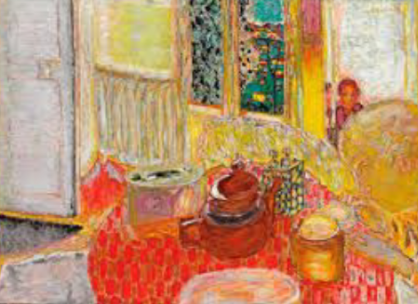
In 1976, while enrolled at Wellesley College, I began to study Pierre Bonnard’s paintings. They immediately enthralled me, and when I think about it, my enthusiasm began shortly after the death of my grandmother. Sarah Whitfield, an art historian who has published articles on Bonnard describes him as the painter of elegy, of the …” effervescence of pleasure and the disappearance of pleasure.” Through the layering of memory and acute observation expressed in a technique of accretion and removal, of building the painting in stages and touches over time,Bonnardreinforces the feeling of life found and lost.Some images appear only after sustained viewing and others can be undecipherable. Some of these one might almost call ghostly such as the many representations of his wife Marthe, which seem practically hidden from view,and some objectsare entirely mysterious.
And then there is the color and the light. As Bonnard ages his work becomes ever more alluring in its range of color. His paintings are a revelation of how color both creates and dissolves light.They do not represent some “bourgeois idyll”1as one critic has imagined them but scenes of life that offer us something much deeper and universal. Bonnard masterfully manipulates value (light and dark) to disclose an ever-shifting reality ofluminosity that merges with deeply saturated obscurityandveils the objects and scenes it depicts.
Finally, as I contemplate why Bonnard’s paintings have become my refuge as well as a source of learning and captivation, my answer is that they are truly like life—always changing—things coming and going, appearing and disappearing and returning, memories floating with reality, light vanishing to darkness, color amazing, but beauty always sustaining.
John Haberman, “Pierre Bonnard: Late Interiors”, Haberarts.com, New York City, https://www.haberarts.com/bonnard.htm accessed June 11, 2021