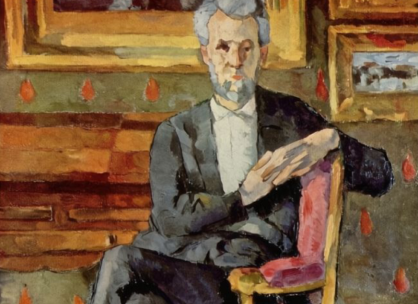
Cezanne, Portrait of Victor Choquet

Victor Chocquet was one of a small group of early supporters of the Impressionists before the group had received recognition for their work. Although he only had a moderate income, he was a passionate collector of paintings, drawings, and other assorted possessionsof value. He was sagacious in his collecting, had an infallible feeling for quality, and had some knowledge of the arts. He preferred relatively unpopular artists whose works were less expensive than paintings by artists more generally well admired. Eventually, he and Cezanne became connected through Pierre-August Renoir.

Cezanne painted six portraits of Victor Chocquet from 1876-1889: four of them, including this one, he painted during 1876-77, one in 1880, and the last one in 1889. This sole full-length painting of Chocquet is quite small, measuring only 18 1/8 x 15 inches, and I ask you to think about why he would choose this size. Two of the four other paintings of Chocquet which include only his head and shoulders are almost as big as this one, and another, a three-quarter figure is almost two-thirds larger. As you can see, he has painted his benefactor here in bright colors that span the whole spectrum from yellow to orange then red, purple, blue, and green. This is unlike the other works he painted of Chocquet, all of which have limited palettes. He has constructed a flat and stable space with the use of strong verticals and horizontals—the back of the chair, the edges of the picture frames, the line where the wall meets the floor (is that a black piece of molding at the bottom of the wall?), and the rug’s edges, the different sections of the desk—seem to be pressing Chocquet into place. However, countering this, is Chocquet himself, who, although his figure and the chair in which he sits mirrors much of the vertical and horizontal compositional features (his torso and head are upright as well as his right leg), feels relaxed to us. Possibly, this is because his left arm is draped over the chair back and his left leg is crossed over his right and swings freely into the space. And the diagonals formed by his conjoined hands and right lower arm, left upper arm, and upper and lower left leg, move us in and out of the space in which he sits.

Another important point. The use of color can amplify as well as diminish the creation of three-dimensional space in a painting. Here I’m speaking of how artists in the past have produced the illusion of depth in a flat painting. I will discuss this and other means used to produce depth,  Cezanne’s focus on the picture plane (or the start of 20th-century painting and abstract art), and my interpretation of this marvelouswork in my next blog, “Portrait of Victor ChocquetSeated, part 2.”

https://www.cezannecatalogue.com/catalogue/index.php

My Father: I Wanted To Be Just Like 
Him

We had tickets to every Broadway show, we went to great restaurants, and we were treated like royalty. We had a good life. He was part of The Greatest Generation. He went to war as a captain in his early twenties and fought in Europe and the Phillipines. He came home and eventually married my mother—who he had loved since high school—and started a family. I think he would have preferred to hold off on that, but my mother became pregnant on their honeymoon.

He loved his family and was committed to us. He was a wonderful grandfather, and my children adored him. He had more friends than anyone I have ever known. Anywhere he went in the world, he always met someone he knew. We had a complicated relationship, good times and bad. I was his first child, and I know he wanted a boy. He was often hard on me, but I loved him with all my heart. I miss him so much.

My Mother: I Had Tremendous Admiration for Who She Was. . .

I was smart, and many of my male peers didn’t ask me on dates until my mother offered me this sage advice: you need to act dumb! I took that to heart, and miracle of miracles, I found that boys became more attracted to me and began to take me out. I even started having a relationship with a BMOC that lasted for 6 years until we got engaged and I broke the engagement.

On a more serious note, I loved my mother deeply, and she taught me so much that was valuable and worthwhile. She was smart, accomplished, and she didn’t suffer fools, including me. Her life had been filled with trauma and poverty into her early twenties, and her main goal in life was to be a good mother. She was that to me. We were different in so many ways, and as I grew up, we staked out our different positions and then accepted each other with respect and love. I had tremendous admiration for who she was and what she accomplished and how much she gave to me. She was my rock, and she always believed I could accomplish whatever I wanted as long as I worked really hard to achieve it. Being a good mother, parent is really difficult work and I celebrate her and all of the imperfect parents who try their hardest to be the best mothers and fathers they can be!

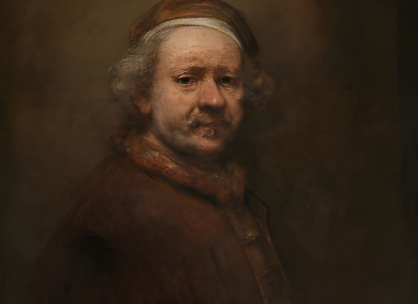
Rembrandt’s Late Work

Rembrandt was a radical innovator, who manipulated paint in the service of the most essential human values. He is a magician who increasingly allowed us to see his manipulation of his means (paint and basic principles of art and design) to achieve an illusion. He transforms his material into gold and silver, velvet and lace and offers us profound insights into the human condition.

In his late paintings, we see love and loss, of material wealth, of those we love and of our youth and vigor. But he shows us we gain in understanding what is truly important, the ability to see the realities of life and ourselves aged and unadorned. I urge you to read this review and look at some of these works. It is not the same as viewing the actual paintings, but you can get an idea of their beauty and meaning. They are particularly relevant to this explosive time when we are all feeling myriad emotions. Rembrandt has them all on display.

https://tinyurl.com/y4wrpemk

What I Learned from my Best Teacher

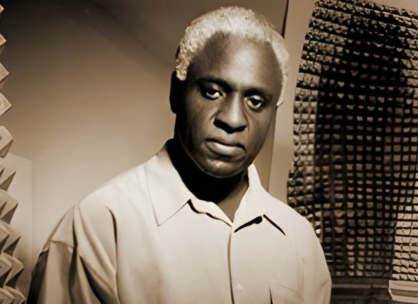
At Wellesley, I discovered that every library book I had checked out had been checked out by Richard Yarde, who had previously taught there. A friend of mine had taken classes with him and spoke highly of him. The next year I moved to South Hadley, Massachusetts, and learned that Richard had a temporary studio nearby in the Springfield Art Museum. I called him, set up a meeting, and requested that he accept me as his student, and after some resistance, he agreed.

I studied with Richard for six months. My assignment was to paint self-portraits in gouache (opaque watercolor) with red and yellow, white and black. Every other week I would present my creations for Richard’s review.Painting with a restricted color palette helped me to recognize how much could be achieved with limited means and to identify value (the lightness or darkness of a color) more accurately.

We also examinedhis work and the work of other artists who he valued and who he thought would be instructive to me. He often assigned an artist for me to study until our next meeting. What I remember from our sessions was the care Richard took in looking at the work I brought to him and the intensity of our discussions about art and artists.

Everything Richard taught me was importantto my creative development, but essential was his making me feel respected and appreciated as an artist. Richard taught me to trust my instincts and ideas. Over the years, this trust in myself has strengthened, and many times it has helped me to workthrough circumstances where I felt belittled and unacknowledged. Richard’s respect and admiration taught me to admire myself—an invaluable lesson.

What I Found on the WWW: Elga Sesemann

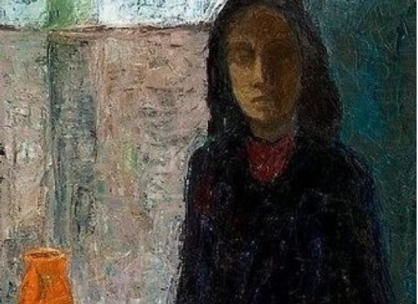
Of course, I can’t be sure of an actual work’s appearance. For instance, her work is heavily textured as she applies thick slabs of paint with her palette knife, a tool with a thin, flexible blade ordinarily used to mix or apply paint. In person, I would feel the urge to touch the heavily textured paint, but on a screen, I experience the mounds and ridges of paint as shadows, lines, and directional strokes. Nor can I be sure the colors are true to the original painting since it is difficult to represent colors truthfully in photographs shown on a screen. Much the same holds for the impact of the painting’s size and the lighting of the environment in which it is shown. Despite these disadvantages, I think it is worthwhile to examine works appearing on the WWW.

In the works that I’ve seen that were produced during and right after World War II, the figures in ElgaSesemann’s portraits and self-portraits are isolated and withdrawn. The figures look inward. Many have one or both eyes closed or effaced; sometimes much of the face is obliterated. The artist uses slashing, heavily loaded strokes of paint in dark, shaded colors to carve her figures out of the shadowy, shallow spaces they occupy.

Are these individuals scarred and suffering loss and sadness? Hardly daring to view the horror they have experienced, they appear unable to hide or deny their experiences. These works are gripping and charged with emotion that is contained in silence.

If you want to learn more and view paintings by ElgaSesemann, visit https://www.elgasesemann.com/en/. If you wish, please let me know how you feel and what you think about her work. I look forward to hearing from you!

My Favorite Painter Pierre Bonnard

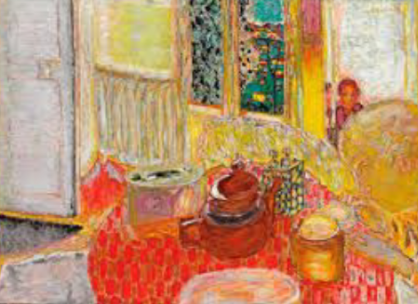
In 1976, while enrolled at Wellesley College, I began to study Pierre Bonnard’s paintings. They immediately enthralled me, and when I think about it, my enthusiasm began shortly after the death of my grandmother. Sarah Whitfield, an art historian who has published articles on Bonnard describes him as the painter of elegy, of the …” effervescence of pleasure and the disappearance of pleasure.” Through the layering of memory and acute observation expressed in a technique of accretion and removal, of building the painting in stages and touches over time,Bonnardreinforces the feeling of life found and lost.Some images appear only after sustained viewing and others can be undecipherable. Some of these one might almost call ghostly such as the many representations of his wife Marthe, which seem practically hidden from view,and some objectsare entirely mysterious.

And then there is the color and the light. As Bonnard ages his work becomes ever more alluring in its range of color. His paintings are a revelation of how color both creates and dissolves light.They do not represent some “bourgeois idyll”1as one critic has imagined them but scenes of life that offer us something much deeper and universal. Bonnard masterfully manipulates value (light and dark) to disclose an ever-shifting reality ofluminosity that merges with deeply saturated obscurityandveils the objects and scenes it depicts.

Finally, as I contemplate why Bonnard’s paintings have become my refuge as well as a source of learning and captivation, my answer is that they are truly like life—always changing—things coming and going, appearing and disappearing and returning, memories floating with reality, light vanishing to darkness, color amazing, but beauty always sustaining.

How I Paint and Why

I start with an idea, photos, and create sketches. When I have what I want, I draw the composition on the canvas, and using an old master method of underpainting, glazing, and scumbling, I layer the paint and redraw where necessary till the painting corresponds to my feeling that it is done.

I find various ways to emphasize the flat plane of the picture surface (2-dimensional space) and simultaneously afford a view of three-dimensional space—a paradoxical design of seemingly opposing types of perception. In joining flatness with depth, I’m drawing a comparison with the many paradoxes we encounter in our lives.

Our lives are a mix of plans and perplexities that lead us to roads never taken. As I paint, I plan, uncover, recall, reveal, and seek to share the feeling of paradox, of life.

My journey varies from painting to painting, and I use sundry tricks to mold my conception. Some of these enhancements happen at the end of the process, and sometimes I spend considerable time trying to figure out what the painting needs. My first teacher told me that as I became more proficient, I would spend more time thinking about my work and less time executing it. I can often spend an hour thinking about where to place a leaf and then take 15 minutes to paint it.

Our lives are a patchwork of planning and surprises that lead us in new directions, and so are my paintings. As I paint, I plan and discover, recall and explore, and most of all seek to share the feeling of life through paradox.

The Meaning of the Message is Us

It often happens that when a person views a work of art they feel perplexed, asking themselves, “What does it mean? What did the artist intend?” and finally shrugging their shoulders and walking away they exclaim, “I don’t get it!” But, are these the right questions to ask, or are there others that might be more useful. What about asking such questions as, “How does this piece make me feel?” or “What do you think the artist was feeling when she/he/they chose those colors?”

The meaning of a piece of art is often complex and personal, personal to both the artist and the viewer. What a viewer sees is dependent not only on what the artist intends for him to see (for instance, what is represented, the colors that are used, the artist’s design, etc.), but what the artist unconsciously communicates in their piece. In addition, the viewer’s temperament and experiences in the world and with other artworks become part of the meaning of the work. To quote a poet, Edward Hirsch, “The reader completes the poem, in the process bringing to it his or her own past experiences.” 1

Art represents different things to different people and can be interpreted in a variety of ways. In some cases, art can communicate a message, evoke an emotion, or tell a story, while in others it may simply be an aesthetically pleasing design. No matter the intention of the artist, art has the potential to take on different meanings for different viewers. This is why many people find art so captivating. It can be a powerful tool for communicating ideas and feelings, as well as providing a unique outlet for expressing one’s creativity.

At last, when interpreting a piece of art, it is important to consider the context in which it was created. To gain a greater understanding of an artwork, it is often important to learn more about the event(s) that inspired it—think of “Guernica” by Picasso. Additionally, the colors, shapes, and lines used may be symbolic, e.g., red can mean passion, love, anger or purple can denote royalty and luxury.

“Guernica,” painted in response to the German bombing of the Spanish city of Guernica in 1937, is rendered in shades of gray. No color is used. It’s one of the most powerful anti-war paintings in the history of art. It’s important to pay attention to these elements as well as the items included in representational works. There is an area of study in art called iconography, which is a system of images in artworks that convey particular meanings.

As you can see, the meaning of a piece of art is subjective and open to infinite interpretations. And it’s always a conversation between you and the artist and the rest of the world. The meaning of the message is all of us.

1Edward Hirsch, How to Read a Poem: And Fall in Love with Poetry (Harcourt, 1999)